


The Delicate Balance: Essential Trade-offs for Robust System Design
Every architectural decision you make carries both benefits and costs. Your success as a designer hinges not on finding perfect solutions, but on strategically choosing which trade-offs best serve your specific requirements. Let's explore how to navigate these critical decisions with confidence.
The Truth About System Design: Everything is a Trade-off 🔄
Think about the last significant system you designed. Did you feel that tension between competing priorities? That's not a flaw in your process—it's the fundamental nature of system design.
As the complexity of our systems grows, so does the interconnectedness of our design decisions. No choice exists in isolation. When you optimize for one quality, you inevitably compromise another. The art lies in understanding these relationships and making informed choices that align with your business goals.
Data Management Trade-offs: Storage Foundations
SQL vs. NoSQL: Structure vs. Flexibility
The database choice fundamentally shapes how your system evolves:
SQL Advantages:
- Strong consistency and ACID transactions
- Powerful query capabilities with complex joins
- Well-defined schema ensuring data integrity
SQL Limitations:
- Challenges with horizontal scaling
- Schema modifications can be disruptive
- Can become bottlenecks under heavy load
NoSQL Advantages:
- Excellent horizontal scalability
- Schema flexibility for evolving data models
- Optimized for specific data access patterns
NoSQL Limitations:
- Limited query capabilities compared to SQL
- Often sacrifices consistency for availability
- Requires careful design to prevent data anomalies
The reality? Most mature systems evolve to use both. Start with understanding your data access patterns and consistency requirements, then choose accordingly. 💡 Pro tip: Don't just follow trends—match your database to your actual data needs.
Normalization vs. Denormalization: Purity vs. Pragmatism
Database design introduces another critical trade-off:
Normalized Data:
- Minimizes redundancy and update anomalies
- Ensures data integrity and consistency
- Reduces storage requirements
Denormalized Data:
- Improves read performance by reducing joins
- Simplifies queries for common access patterns
- Speeds up frequent reporting operations
The balanced approach? Begin with proper normalization, then strategically denormalize only where query performance demands it. Monitor your most frequent and performance-sensitive queries to identify candidates for denormalization.
The CAP Theorem: Choose Your Compromise Wisely
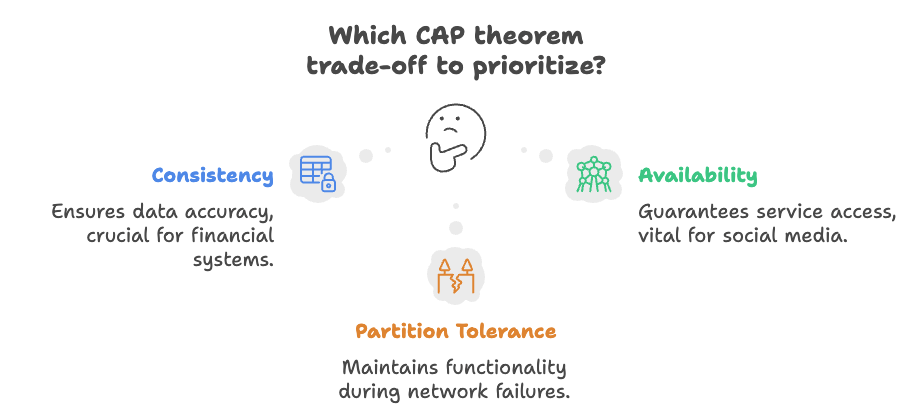
When building distributed systems, the CAP theorem forces a fundamental choice between:
- Consistency: Every read receives the most recent write
- Availability: Every request receives a response
- Partition Tolerance: The system continues to function despite network failures
Here's the tough reality: When network partitions occur (and they will), you must choose between consistency and availability. Banking systems might sacrifice availability for consistency, ensuring account balances are always accurate. Social media platforms might favor availability so users can always access the service, even if they occasionally see slightly outdated content.
This isn't a one-time choice. Different components of your system may make different CAP trade-offs based on their specific requirements. Think about the business impact of each option before deciding. ⚖️
Processing Paradigms: Batch vs. Stream
How you process data represents another fundamental decision:
Batch Processing:
- Computational efficiency through economies of scale
- Simpler error handling with retry mechanisms
- Comprehensive analysis of complete datasets
Stream Processing:
- Real-time insights and immediate reactions
- Reduced processing latency for time-sensitive operations
- Continuous processing model aligned with event-driven architectures
The choice depends on your specific time-sensitivity requirements. Many modern systems implement a hybrid approach—using streams for time-critical operations and batch processing for comprehensive analytics.
Performance Trade-offs: Speed vs. Scale
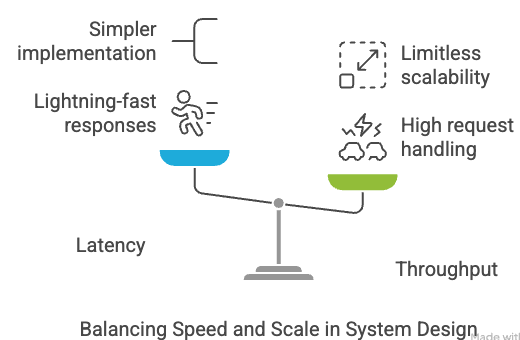
Latency vs. Throughput
These two performance metrics often compete:
- Latency: How quickly the system responds to a single request
- Throughput: How many requests the system can handle simultaneously
Optimizing for low latency often means dedicating more resources to each request, which can reduce total throughput. Conversely, maximizing throughput might mean batching operations together, increasing the latency for individual requests.
Consider your users' expectations: Do they need lightning-fast responses to individual actions, or is the system's ability to handle peak loads more important?
Vertical vs. Horizontal Scaling
When your system needs to grow:
Vertical Scaling (scaling up):
- Simpler implementation with fewer distributed system complexities
- Better performance for workloads that don't parallelize well
- Limited by hardware constraints and single points of failure
Horizontal Scaling (scaling out):
- Nearly limitless scalability potential
- Better fault tolerance with no single point of failure
- More complex to implement and maintain
The practical approach? Use vertical scaling for simplicity until you reach hardware limits or need improved reliability, then transition to horizontal scaling for components with the highest growth rates.
Architectural Trade-offs: Monolith vs. Microservices
System structure introduces its own set of compromises:
Monolithic Architecture:
- Simpler development and deployment workflow
- Lower operational complexity and network overhead
- Easier debugging and testing across components
Microservices Architecture:
- Independent scaling of components
- Technology diversity and team autonomy
- Improved fault isolation and resilience
Before leaping to microservices, honestly assess your organizational readiness. Microservices trade application complexity for operational complexity—make sure you're prepared for that shift.
Making Better Trade-off Decisions
The key to effective system design isn't avoiding trade-offs—it's making them deliberately:
- Identify your non-negotiables: What absolutely must your system provide?
- Quantify requirements: Replace vague goals with specific metrics (e.g., "99.9% uptime" instead of "highly available")
- Consider the full lifecycle: Today's perfect solution might become tomorrow's technical debt
- Document your reasoning: Future teams need to understand why certain trade-offs were made
- Plan for evolution: Design flexibility into areas likely to change requirements
Remember: "Everything is a tradeoff. Everything. Even expanding that field in your DB that will enable a critical user feature comes at a cost. Don't even think about adding a load balancer or async task queue until you understand why that is the most effective use of your company's engineering resources at that time."
Conclusion
System design excellence comes not from avoiding trade-offs, but from making them intentionally and appropriately for your specific context. There are no universally correct choices—only trade-offs that better align with your particular requirements.
By understanding these fundamental tensions and approaching them strategically, you can create systems that effectively balance competing priorities and stand the test of time.
"System design is all about making the right trade-offs. Whether building something from scratch or scaling an existing application, understanding these core trade-offs will help us make better architectural decisions."
References
- ByteByteGo: System Design Was HARD - Until You Knew the Trade-Offs
- GeeksforGeeks: Tradeoffs in System Design
- DesignGurus: Navigating Complex System Design Trade-Offs Like a Pro
- AlgoMaster: System Design: Top 15 Trade-Offs
Please share this article with your team and let me know which trade-offs you've found most challenging in your system designs! 🚀 Hit the contact button below to get in touch—I'd love to hear about your experiences and explore potential solutions together.